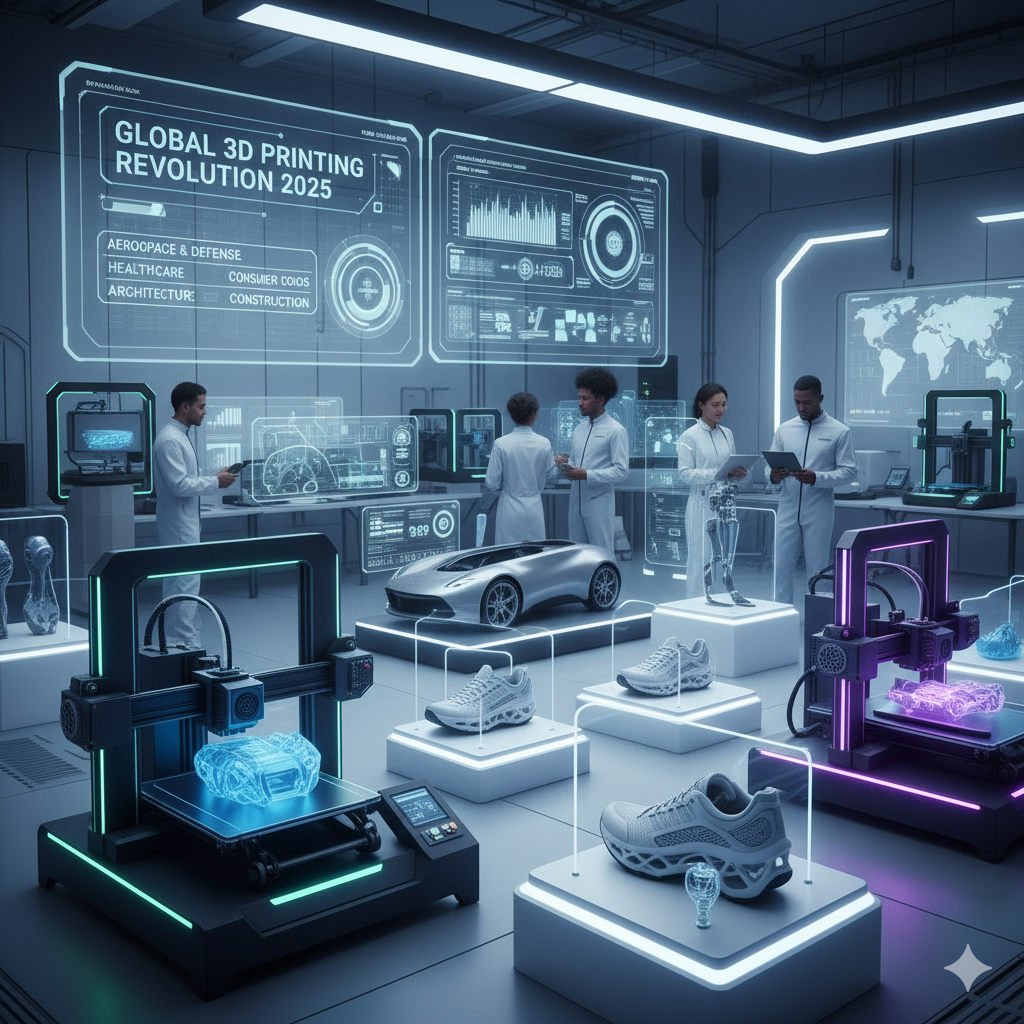
As we advance through 2025, 3D printing technology continues to revolutionize industries worldwide with innovations in sustainable materials, metal printing, AI optimization, and faster processes. Leading sectors are embracing additive manufacturing not just for prototyping, but for full-scale production applications.
Healthcare: Medical Miracles in Motion
The healthcare industry exemplifies 3D printing's transformative potential. AI-integrated 3D printing has improved vascular tissue graft success rates by 35% in 2025, while dental applications have streamlined restoration production with unprecedented precision. From custom prosthetics and surgical planning models to bioprinting organs, the medical sector demonstrates how personalized manufacturing saves lives and improves patient outcomes.
The dental 3D printing market alone surpassed $3 billion in 2023 and continues growing at over 20% annually, reflecting the industry's confidence in these transformative technologies.
Aerospace: Lightweight Innovation
Aerospace companies leverage 3D printing to produce complex, specialized components using advanced composites and metal alloys. The technology enables significant weight reductions, cost savings, and enhanced fuel efficiency for aircraft manufacturers. Companies like Airbus utilize additive manufacturing for high-temperature alloys and precision components that traditional methods cannot efficiently produce.
Automotive: Speed and Customization
The automotive industry employs 3D printing for prototyping, custom parts, and specialty vehicle production. BMW and General Motors create complex assembly line jigs and manufacturing aids, while companies like Bugatti use the technology for limited-edition vehicles. The process offers faster production without quality compromise and enables manufacturers to assess vehicles and components before full-scale production.
Construction: Building the Future
Construction applications demonstrate 3D printing's potential for large-scale manufacturing. The technology enables on-site printing of components, facades, ornamental features, and interior elements with complex geometries impossible through conventional methods. This approach reduces material waste, construction time, transportation costs, and environmental impact while enabling sustainable building practices.
Consumer Goods: Mass Customization
The consumer goods industry utilizes 3D printing for personalized and customized products ranging from phone cases and kitchenware to toys and gadgets. This capability allows businesses to create products that reflect individual customer styles and needs, opening new market opportunities for customization at scale.
Marine and Entertainment: Expanding Horizons
Marine applications benefit from corrosion-resistant materials and the ability to produce large components like custom interiors and propulsion systems with reduced lead times. Theme parks are revolutionizing entertainment by creating unique, immersive environments and large-scale installations that would be impossible with traditional manufacturing.
Looking Forward
By 2025, enhanced multi-material printing, automation integration, and sustainability advances will further expand 3D printing applications. As the technology continues maturing, businesses across industries will discover new ways to leverage additive manufacturing for competitive advantage, cost reduction, and innovation acceleration.
These blog posts provide comprehensive awareness about 3D printing benefits and applications, helping your customers understand why they should choose 3D printing services and how the technology can benefit their specific industries.

Selecting the right material and design approach for your 3D printing project can mean the difference between success...
3D printing has evolved from a prototyping tool to a game-changing manufacturing solution that offers unprecedented advantages over...
Copyright © 2025. 3DPrintwala. All Rights Reserved